Wednesday, November 14, 2018

UNRESOLVED

Sadly for me, a proud Texan, there were very few images in this project representing Texans. But towards the end of the acquisition I finally recognized a famous Texan,  famous for being an Oklahoman!

 Finally! A Texan! Temple Houston was an Oklahoma
lawyer, gunslinger, and sometime politician.  He was
 Sam Houston's youngest and most genetically similar 
son... even though he never really knew his father. 
 
 Due to difficulty, I waited as long as possible before unveiling this portion of the Russell Cushman Historical Image Collection. This was a challenging puzzle, with four brothers who shared a strong family resemblance. 

First the flamboyant and idiosyncratic Temple Houston, fourth son of Sam Houston, showed up on a CDV in one of the auctions where I had been snagging historical images for almost a year. As usual, the seller could not provide identification or provenance. Still, I knew it was him, and eventually found several more of his brothers...

There are very few images of the Houston children, which in itself is something of a mystery. Their father was an extroverted politician of great importance in American history, and certainly was painted, sculpted and photographed to the saturation level. But it is as if the children and Mrs. Houston were sequestered all of their lives, with scant and dimly lit peeks of them made available through limited family channels. Now my photographs prove that there were some... but perhaps they were loaned out for publishing purposes and never returned. Until NOW!

Considering the context of the rest of the collection, I believe that if I keep digging, will find somewhere that Albert Bigelow Paine, one of America's leading biographers, and the central culprit in this whole blog, at one time considered doing a biography of either Sam Houston or Temple Houston. And as I have displayed here, if my theories are correct, he was something of an image hoarder.

 #1, Andrew Jackson Houston, named after Sam Houston's
 close friend and commander and President of the United States.
Andrew was the second oldest, but was not old enough to 
serve in the Confederacy, but served later in the National Guard.

 Just some of the photos, nicely arranged,  which guided 
my identifications of three of the Houston boys, numbered
1 - 4. Ironically, the larger portion of them was of Andrew, 
a man my father knew well and interviewed for his book.
 
First Temple and then several tintypes emerged with boys that looked very Houstonesque.  They looked very much akin, but it would take me a long time to make this final graphic, organizing them, and hopefully correctly identifying them, using every photograph I could find for comparison.  I never did see a photograph of Sam Jr., who was the oldest and less likely to have been photographed as a child, since he was born before photography had even come to frontier Texas. 

But certainly after the Civil War, photography had come of age, and was available to the upper middle class in the larger population centers. The problem was the younger children were usually kept at home, which was probably Independence, Texas for most of them, and rarely seen in the political circles where Sam spent most of his time. The CDV (#4) of Temple in a suit was probably made when he served as a page in Washington D.C. when he was 15 or 16. By then he had already driven cattle all the way to the Dakotas, worked as a night clerk on a riverboat on the Mississippi, learned the "ways of the world," and then negotiated an appointment as a Washington page by a U.S. Senator.

 #2, Andrew Jackson Houston in his late twenties. This one
 well illustrates the Houston ferocity.  Andrew was not as 
handsome as the others, but was actually appointed to
 the U. S. Senate from Texas, right before he died.

I will admit that the photos, numbering 1-4, are not the most flattering, but because they were grouped relatively close in an Internet auction march of thousands, I felt then and still feel strongly that they were related. And they certainly do look like Houstons. There is that intense scowl... with powerful lips, but basic good looks that ties them together. The toughest thing was to tell them apart, with no clues. The ears were the only way to differentiate one from another.

#3, Little William and Andrew Jackson Houston, 
about 6 & 10, around the end of the Civil War-
perhaps dressed for their father's untimely funeral.

Here are some of the most acknowledged sons of Texas,  all of which grew up in public shame after their father refused to lead Texas in Secession and joining the Confederacy, and was forced out of the Governor's office. They had to find their own way while time would eventually prove the Houstons were on the right side of history.  All of them would have made Sam proud at one time or another, but some of them, especially Temple, would have frustrated the hell out of him. Sam Houston died during the Civil War, leaving the children to be raised without him. His devoted wife passed away soon after, and Temple and William were raised by their sister. The military and political legacy of his father, combined with the frustrations of defeat during the Civil War and the ostracism of his family because of his father's stance forged Temple Houston into a fierce young man with something to prove. And he soon chose someplace else to do it.

Temple Houston's life story included a law degree, political appointments, and a scandalous legal career which included shooting his pistols during a trial in his adopted state, Oklahoma. It is too much to cover here, but he would have been an intriguing western character to inspire a popular biography, but if anything, even Albert Bigelow Paine, the original spin doctor, might have hesitated. 

There were at least two biographies written about him in the late Twentieth Century, the better one by Glenn Shirley; Temple Houston- Lawyer With A Gun. 

A Picture of Mother's Love... or something

Look past the softness. Ignore the beauty. Probably copied from an earlier ambrotype, this is the face that launched a thousand nightmares...

 
 Mona Lisa had nothing on this portrait, which I believe
 is the Mother of THE most famous Outlaws.

 This old image could be controversial. Only because of what I think and there is almost NOTHING TO COMPARE TO. Many of the other images here can be compared to historic images of similar age to derive how correct my guesses are. But not this one.


I believe this is Zerelda James Samuel, "Mother of  Battles- post-Civil War," the infamous matriarch of the James clan, who provided the nurturing which shaped two killers, Jesse and Frank James, who invented bank robbing and perfected train robbing in Victorian America. She aided and abetted their campaigns, harbored them between crimes, and gave up at least two other children to their cause... if our theories are correct.

According to history, Zerelda was as tall as most men, commanding, and defiant of most authority, and some accounts say that she was quite beautiful in her early life. An outlaw queen. But up until now, we could only imagine.


 Here brightened and reversed for comparison, showing the 
same open stare, and the exact triangulation between 
the eyes and nose, of a known likeness of 
Zerelda Samuel. The hand-colored image 
in the upper right is like mine, 
only a proposed image
 of Zerelda.

She is said to have had fiery relationships with a stepfather she barely endured, and her first two husbands who died young... one (James) supposedly in the California gold fields, the other (Simms) was fortuitously killed by a horse- right after Zerelda decided that she wanted to divorce him. A tough survivor of frontier rural life, she owned and bossed slaves with imperial callousness, yet maintained their devotion. She managed the family farm and brought fives sons and three daughters into a harsh world, and raised most of them to maturity.

During the Civil War, her third husband, Dr. Reuben Samuel, was repeatedly hung from a tree and dropped before asphyixiation, until he was permanently brain damaged, and left for dead by Union investigators. Still, they managed to produce one more child, Archie, in 1866. In the end, she had lost at least two of her children to violence, and her right arm in a law enforcement raid. She never seemed to react as others would expect. When the Pinkertons threw a flare into her home to illuminate the interior, she knocked it into the fireplace, causing it to explode and rip off her arm and kill little Archie, her youngest.

Needless to say, after showing so much pluck, many Southerners sympathized with her, and Missourians united to support the James Gang in their battle against a relentless foe; the North.

This half-plate tintype was acquired near the end of the gathering of this whole collection. As the collection increased, I noticed that the larger tintypes were almost always of supremely important people to American History. There were not that many, but among them were Winslow Homer and Libby Custer. They were either prestigious gifts or cherished loans by the subjects. Either way, when this tintype became available, I snatched it immediately and thought about it later. I was not sure who it was, only that the woman was pretty and had a disturbing deadpan stare.

Later it hit me, and still it was such a long shot. It was not the first time I had purchased a tintype, only later to become convinced that it was perhaps the only image of a historic person at a certain age with nothing to compare to. Understand, that I would never have fancied such a possibility, had I not just purchased a dozen or so James-related images. In fact it took me awhile to believe all of this and imagine that the swelling collection was as historically significant and comprehensive as it was. Several times I thought to seek- and then found important tintypes, only after I had acquired images of their friends and children. I realized that if I had snagged all of these lesser characters, then perhaps I was overlooking the main ones! And often I was. My recognition skill was limited to images that I had seen and grown up with. People change so much from childhood to old age, nobody would recognize some of these people without help.

Sometimes, imagination is the best kind of help you can get. And I have spent a lifetime calling upon mine.

So after I imagined that this might be Zerelda, and made comparisons, only then it became very exciting that I had made a very important discovery in history. 

But at first the only thing I focused on was her eyes. Zerelda's eyes were... blank, somewhat mismatched like a doll's eyes. Her perpetually raised eyebrows forbid interpretation. She looked almost stupid or ambivalent. Yet her reputation of personal prowess contradict her empty countenance. Zerelda had the lifeless eyes of someone who had endured so much that she was impervious to almost anything. Almost what you would imagine the eyes of a sociopath might look like. But that was just the beginning of my primitive facial recognition test.


Later I recognized how much Zerelda and her oldest son Frank James favored one another, in their advanced years. I had always considered Frank the long-faced and unattractive child in her brood... almost appearing to be from a different father than handsome Jesse. But in old age, they grew to look more and more like one another; The flattened nose, long ears, empty eyes, and the apparent loss of teeth.

Take off Frank's mustache, and put a wig on him... and you pretty much have Zerelda.  

No arguments there. So then it hit me... the large tintype that might be Zerelda, if she looked like Frank James in his youth... THAT would certainly be something. A familial similarity that defied coincidence. And she does... and in fact her resemblance to little Archie is absolutely stunning. Somehow it is coming through to me, as these faces stare back, the fierce mother's love which united all of them. But then I am an artist...

So here is a proposal of mine. Unlike others where there are similar photos to compare, this one requires some suspension of disbelief and some imagination... and an open mind. And a large dose of benefit of the doubt. But I think, given the strength of the others, it is a wonderful proposition.

Friday, November 9, 2018

Mark Twain and JESSE JAMES! Do YOU believe?

It is a scientific truth that things do not fall together. Nobody can explain the Universe or a single atom, or how or why they came together. Or how or why they stay together. Things never fall together, and given any opportunity, they will always try to fall apart. So when they do fall together, it is something like the Creative Force of the universe willing it so... 

 Upon meeting, Jesse supposedly said to Mark Twain, " I suppose we are the greatest in our line."  [Image is totally photo-shopped.]

At the heart of my theory on this blog - is the shear number of images which have an uncanny resemblance to famous people who were in some way related to one another, all discovered from ONE SOURCE.  HUNDREDS.  Over two hundred interrelated people who can be tied to Mark Twain or his biographer, Albert Bigelow Paine.

But when I started this project, I had no idea just how related they would turn out to be. My first major clues were provided by GOOGLE Search which effortlessly showed me who to look for.   After I recognized someone pictured in an auction, GOOGLE would find me pictures to compare to, and more importantly, would also (unsolicited) show me the faces of persons which were associated with the person I was researching. That is the mind of a search engine... ANYTHING related. It would teach me and familiarize me as I dug into a particular person's “image community.” That way when a familiar face (because of my endless surfing on GOOGLE) popped up in an auction, I may not have known who they were, but I recognized that they were known historically as a family member or associate to somebody I already researched.

In some cases, the relationships suggested by GOOGLE were absolutely correct, although shocking to me. I had a lot of reading to do!

There was a lot of back and forth. And this research has also led to many dead-ends and false alarms and disappointments. There were seemingly scores of certain individuals who had too many look-alikes. Sometimes I wondered whether I was delving into a collection of carefully assembled look-alikes. In fact Mark Twain and A. B. Paine were actually obsessed with the prospects of look-alikes, and used the concept in several books. 

 An example of the acceptable likenesses of outlaws of the time.

And then there were the unexpected historical inconsistencies. Before 1880, many famous people, especially those “out west,” were poorly or rarely photographed, or in some cases popular, historically accepted images of them were not them at all. For many recognizable western personalities, the best image we have today is a picture of a picture of a picture. So desperate were the early writers to get published, they often used poor quality or bogus photographs to strengthen their chances of publication and improve on subsequent sales. Most people, including law enforcement, had never seen a clear photo of the most famous outlaws until they were propped up, stiff and grimacing, outside some frontier morgue after they had been eliminated from the Most Wanted list.

And there was lots of monkey business with the criminal corpses as frontier photographers seized the opportunity to make a buck off of these grisly images of bullet-riddled badmen-made-good. But actually, there were practical reasons for obtaining good photographs of the most famous outlaws, even dead. Besides the fact that the public wanted to see and the papers wanted to show them, law enforcement agencies all over needed them to clear look-alikes, satisfy ID confusion between outlaw siblings, and to be sure sought-after criminals with large rewards were actually dead. The public release of these photos also helped promote the idea that crime did not pay.

Still every mother's son loved to read cheap western publications which sported sensational images of American criminals, dead or alive. Dead, wild-eyed outlaws with their guns laid artistically across their perforated chests were a bonus!

 In this collection was only one such photo which I acquired for soon-to-be obvious reasons. Once again the seller had no idea what it was, and to me it looked a lot like Jesse James. Since I had already acquired around a dozen James family related tintypes, from the same seller, I could not pass on it, even if there were some “problems” with it.

I have thought about it a lot, even talked with an undertaker, trying to satisfy myself about the anomalies. In the meantime it got a lot more complicated with the reading of JESSE: A Novel of the Outlaw Jesse James, by Max McCoy. I had missed it completely, when McCoy released this captivating book in 1999, which did not make a huge splash in history. And it's a good thing it didn't. Because McCoy made the whole thing up and led many of us, who trusted him astray.


IF you are interested in Jesse James, or the supposed (original) author of this book, Mark Twain, or just want to read the most convincing guerrilla soldier's account of the Civil War (that I have encountered) then this book is sure to grab you as it did me.

In a nutshell, according to McCoy's story, Jesse James approached Mark Twain long after his supposed demise, and gave his personal account of his life to be written and published by Mark Twain... “when the coast was clear,” we assume. It is a very convincing account, and given the shameless, well received lies Mark Twain published, McCoy should damned proud of himself.

It was a killer. In every respect. The condition and the circumstances surrounding McCoy's incredible "find" suggest a possible legal entanglement, and even a fire, and a rescue from it, and certainly damage and a loss of pages in the manuscript.But of course, much later he came out and admitted the whole thing was a hoax created when  he was suffering from a a sort of writer's slump. In fact Max McCoy claims he doesn't even remember writing the story.

You will have to read the book to answer your multiple questions about how all this transpired, because I need to get to the meat of my part of the story. According to McCoy's tease, which he admits was a hoax, Jesse James successfully faked his death with the help of his wife and the Ford brothers, (James's cousins) who had been offered a generous reward to deliver him dead. Very handily, John Thomas Samuel, a younger half-brother of the most Wanted Man in America, just happened to die from an old gunshot wound and was conveniently laid in his place. The rest was fake history.

John Thomas Samuel even favored Jesse in appearance and general description, and since very few people had ever seen the outlaw, and only one somewhat recent photo of him was in circulation, and (like Jesse) the corpse sported a full beard which helped to disguise him for any skeptics, it was a smooth deception. Never questioned, the switch miraculously gave Jesse James a chance for a new start in life. According to the story, it required Jesse's wife and family to move away and start their own life without him- in Kansas City. This was an acceptable option compared to the life they had.

To add to the illusion, the book is damn well written, although seemingly not Victorian enough to be from Twain's pen. Expletives and other profane situations in JESSE seem to be major exceptions to Twain's otherwise fairly Midwestern propriety.  And up till now, nobody knew what Jesse James might say if he had the chance. But I propose that even Jesse would not have formed some of these thoughts and words... in many ways he was more chivalrous than Mark Twain... and it would take a day to make all those points, so I would rather make my argument for what the wonderful manuscript that McCoy published was.

Max McCoy readily connected the manuscript with Twain's biographer Albert Bigelow Paine, establishing what everyone now calls plausible deniability. In other words, Paine, the bad guy of Twain lore, wrote it. Kind of like the Devil made me do it.  IF Twain had somehow met with Jesse James, he would have handwritten the notes and even the final manuscript, to then be transcribed. The fact that McCoy claimed that he worked from a badly damaged, typed manuscript brings a third chef into the stew. (But there only ONE!) The book was written to make every impression that it was a joint effort, if not somewhat contentious, between Mark Twain and Jesse James, but that could have been only part of the evolution of this manuscript. 

Then it laid fallow for almost one hundred years. 

Many details are related by James (or whomever) which are little known facts, and almost impossible to have been recorded by any other than a James family member. It seems unlikely and almost impossible for this detailed, introspective confessional to have been a product of some Twentieth Century researcher. The age of the typed story, mildly edited by McCoy, placed its origins long before this kind of exhaustive research had become a standard in historical biography. And frankly few writers then (or now) could have conjured up the stink of war and the smell of black powder which reeks from this unpretentious account.

Too bad it was all a lie. It is a masterful work that reads believably as the forging of these two American legends... “the greatest in their lines” as James supposedly remarked at their first meeting.  Since it is NOT them, and not a legitimate collaboration, then the creator of this ruse is to be adored and congratulated. One HELL of a storyteller. It is a work of genius on several levels, and stands on its own.


Still, I am hard-headed, and McCoy turned me on to something valuable here, a very intriguing theory about Jesse James's faked death.. let's go back to the last time we saw Jesse. In the coffin. There must have been dozens of photographs made of Jesse during that famous session after his assassination. Supposedly Bob Ford killed Jesse with a .44 caliber pistol, sending a large projectile, at almost point blank. It is hard to image the small amount of damage done to the forehead of the deceased. The baby face of the bearded man looks to be in his twenties. Jesse was a hardened 35. Think 50 in human terms. And Jesse had very high, very prominent cheekbones, totally missing after death! Jesse also had a long turned up nose, with a substantial bulb on the end, totally missing after death! Jesse had thin hair, and a receding hairline, conveniently covered by a beautiful head of hair, after death.

 An authentic photograph, known in antique circles as a "CDV" of Jesse James.

But that is not all. Not only was his face either obscured by facial hair or just not right, those who prepared his body for burial were careful to arrange his hands in each photo so the missing digit on his left hand could not be seen. Because it was not missing! They did however rip his shirt open to display “old” Civil War wounds... which were right where... brother John Thomas had been shot as well. 

 All images of James are accepted as authentic, 
except mine in the middle, which is relatively unknown.

You can't make this stuff up. Look for yourself... And then there is my photo. I bought this because it looked like a dead guy... who could be mistaken for Jesse James. Propped up in his burial suit, hair mashed from being crammed into a casket that was too short, (or later into a body bag for transport) his ill fitting clothes look like somebody struggled to dress him and then gave up... and took the photos in a rush, but why? Better photos had been taken, when he had first been brought in, his shirt “still bloody” from the shooting. 


 It looks like somebody wiped a bloody hand on his left shoulder, as if trying to create the impression of violence. But the individual finger prints are easily observed. Someone, probably a relative had cleaned him up and prepared him to be photographed for posterity. But a large caliber bullet from behind should have left considerable damage at the exit hole. Pleasant faced “Jesse” sports a moderate gash above his left eye. In more probability, it was a much smaller bullet, and according to the book, applied after death. The whole family was in it up to their lawless eyeballs, or at least up to their cunning smirks.

If in fact they were part of a body-switch plan to release Jesse from his tortured life, they would have known how important it was to deceive and not raise suspicions. And getting convincing photos was important to satisfy the authorities. Many a Pinkerton man would want to inspect them. They craftily provided a body with a bullet that could pass for the Southern folk hero. It was every bit as outlandish as attacking the Northfield bank.

Notice how Jesse's head is bent slightly to make
 him fit into a casket which was almost too small.

Meanwhile the differences between my dead Jesse and theirs are explainable. Only the dead man's ears keep the two likenesses from being the exact same man.

It is apparent from the first and most famous postmortem photos and illustrations of James that they had trouble getting John Thomas/Jesse's eyes to stay closed. This was not unusual. After the body was put on ice, to retard deterioration, the skin became even less flexible and whatever expression was achieved would become fixed until professional techniques could be applied (And probably never were).

In other words, a dead body sometimes has a life of its own. 

"Jesse" was taken by train to his home church in Clay County to be viewed by friends and family before burial. I propose that my photo was taken by law enforcement on the other end of the train ride, not for posterity but to finally provide a face for their files. They may have been unaware or distrustful of the first series of photos. He had probably been shipped in a bag and laid on his ear and so his ear appears to stick to his head... rather than angle out like it should when thawed out. They sat him up, now hunched over and stiff from being shipped in a iced down box, and put on his burial clothes. He looked far from natural. A frontier photographer would not care whether his eyes were closed or staring him in the face... as my Jesse sleepily tries to do. They just wanted proof... that the most wanted outlaw in history was permanently retired.

I'm sure some lawmen later studied the photographs and were still not satisfied. Nor should they have been. But there was no way they were going to pursue their suspicions. And how could they? The evidence was buried, they still had no likeness of Jesse James to compare to, and John Thomas Samuel was unavailable for comment.

Very few people knew about Jesse's half-brother who had been struggling for life at home. He had been wounded at a party, almost died, went into a coma, then recovered, then, according to the book, (and unknown to the outside world) he suddenly died after some time passed. And here opportunity presented itself, to a desperate and devious clan. The Samuels had always been a very remote, private network of counterculture. There was a network of deadly protection surrounding the Samuel household. Several detectives had gone there never to be seen alive again. When the body was interred on the property near the house, that would have been the appropriate and least accessible thing (for inquiry) they could have done. And if John Thomas got up and walked out, nobody would know or care.

 So far, I have found only one photo of "John Thomas Samuel" 
(upper right).  Compare! None of these faces look like
 the authentic Jesse James (right-center & bottom right). If the
 old man is Jesse, his nose grew some (plausible) but he
 appears to have the expected triangular face and those
 high cheek bones.

 The only known photo of John Thomas was taken with
 Jesse's son (left), born in 1975, who appears to be in his
 mid-forties. This would make John Thomas 59.
 Jesse James would be 73.

According to McCoy's book, It is John Thomas Samuel buried in Jesse's grave... or was, as he was exhumed and moved to be buried next to Zee, Jesse's wife, after she passed away. Then exhumed again much later to compare his DNA to descendants. The DNA tests were positive, only proving that the remains were a match to the James family... but it could have been Jesse or John Thomas, or any male offspring of Zerelda Cole James Simms Samuel.

Could it be that even though McCoy told a whopper, part of his account about James is true? Even the truth about Jesse James? If not, whatever happened to John Thomas Samuel? If he lived until 1932 as his family claimed, how is it that there are so few photographs of him?


 You have to wonder, how these discrepancies have been ignored so long...


 William Pinkerton, the detective blamed for the tragic explosion at the James/Samuels home, where little Archie Samuels was killed. He later confided that he intended to burn the house down.


McCoy's elaborate tale really hit the spot, for Twain and Jesse James enthusiasts. Although Samuel Clemens had spent most of his time in  Missouri across the state in Marion County, he had a lot in common with the outlaw. They had both grown up in Missouri river towns, he on the Mississippi, James on the Missouri. Raised in a slave-holding state, they both enlisted in local Confederate militias during the Civil War. Both claimed the discomfort of having killed men during the war and had trouble with wartime atrocities they witnessed. 

 The X's are Confederate guerilla engagements by either Quantrill or Bloody Bill Anderson. The money signs represent bank or train robberies by the James-Younger Gang.

Most of the engagements and atrocities committed by Bloody Bill Anderson and his guerillas, which included Jesse, were right between the two men's hometowns.  Half a dozen of the guerilla attacks were just a days ride from Hannibal, where Mark Twain based many of his writings. Twain openly described himself as a "border ruffian from the state of Missouri."  Thus both men hated the Pinkertons, politicians, and neither had much use for preachers.  All through JESSE, one can read Mark Twain's sentiments about war, slavery and the human race through Jesse's dialogue.

IF Twain met Jesse James as an old man and agreed to write his story, IF he wrote it or at least started it, IF Paine finished and typed it, then what Max McCoy published as a curiosity was in fact one of the most significant manuscripts of the Nineteenth and Twentieth Centuries. But alas, it was just out of McCoy's devious mind. And as wonderful as it is, it is bound to generate a whole knew generation of Jesse James mythology. I totally enjoyed the novel and it drove me crazy about six months until learned the truth about it. McCoy really created a stinker.

And deep down, I think he knew it.

By the way, Max McCoy is the creator of Indiana Jones and the author of several novels about him... and has written many books himself. After that kind of success, he might understandably have let a dead dog lie. But it was too tempting... a story, that if it had been true, would have been the story of the 20th century.

Later he has published groundbreaking information about Albert Bigelow Paine, and his astounding indiscretions, which you can read about below. 

Saturday, November 3, 2018

Mark Twain's least known obsession

Most lovers of things Twain are aware of his love of Joan of Arc, her, her legend, the book he wrote about her. His love of women in general. He rarely missed an opportunity to edify women in society. Twain loved to tear down the mighty and encourage the less powerful; to balance the scales of social justice. He loved underdogs. Travel. Adventure, as long as he didn't have to sweat. Obviously, he loved to write. He loved making fun... of people, himself... but he is not famous for his most absurd satires about ... detectives. And there is a reason. It was not his best work.

Still, among this collection, which I believe came from the files of America's most beloved author, were a number of photographic images of the Pinkerton men. Allan Pinkerton founded the predecessor of the Secret Service when Abraham Lincoln was elected and spied for him during the Civil War, and eventually started an independent detective agency, which became famous the world over. 


 Originally named Samuel Clemens, Twain may have learned of them through his brother Orion Clemens, a Lincoln appointee who served as Secretary of the Nevada Territory. A Southerner at heart, Sam stayed aloof of the war, after serving shortly as an officer in the Confederacy when U. S. Grant invaded his station. He immediately sought safer climes when the shooting started.

As a Missourian, he would have followed the adventures of the Pinkertons during their most deadly and frustrating assignment; the pursuit of the Southern outlaw Jesse James and his gang. We have reason today to believe that Mark Twain not only met Jesse James but may have been entrusted to tell his life story. 

So it would not have been strange to find photos of these two groups among this huge collection, even though Mark Twain was consistently sarcastic if not downright cynical about the Pinkertons and their kind. Several lesser known Twain novels made a public mockery of all detectivedom; The Stolen White Elephant; Simon Wheeler: Detective. He even made Tom Sawyer into a detective! He seemed to love heckling the legendary lawmen, even when they were probably tracking him during his bankrupt years- for his exasperated debtors. HOW he obtained such personal images.... of Pinkerton's sons as youths, even Pinkerton's daughter... is a mystery. 


My guess is that if Mark Twain, one of the most famous writers in the world, contacted the Pinkertons, expressing his intention to write a detective novel, or perhaps a biography of the agency's founder, they would have seen the inquiry as a huge public relations opportunity. 

Photographs of the Pinkertons were not available to the public, for obvious reasons. Photographs of their families even less. Only someone of impeccable reputation would have been made privy to such things... only someone like Mark Twain. Twain's closest friend and official handler, Albert Bigelow Paine, later specialized in biographies of the most important contemporary Americans... and even did a bio of the famous Texas Ranger Bill McDonald, and might easily have negotiated with the second or third generation of Pinkertons when the glory days were over, to do a biography of the world's most famous detective. 

However the images found their way to an Ebay auction, along with hundreds of other rare and important Victorian tintypes, we will never know. But the chance to look into a Pinkerton family photo album has never been seen before. Anywhere.

Two tintypes which feature the legendary detective, Allan Pinkerton. The one in the center is a rare image of Pinkerton, after his stroke, I believe because of the frailty in his normally menacing eyes and the unpretentious grimace.  The other, what is sure to be a controversial pose with a young Charlie Siringo, maybe before they were even supposed to have met! I am proposing that Siringo sought out The Pinkerton agency, perhaps as an informant, even before he released his first book. In the book he claimed to have more than casual knowledge about Billy the Kid and his gang. He may have posed with the famous sleuth as a budding writer, never imagining that someday he would be working for him as a detective, in fact one of the agency's most trusted. 


 One of the few large cabinet cards in the collection... in the middle and the face on left enlarged for comparison. William was the bad ass, Robert more the office type.


This seems to be a gathering of ex-Pinkertons. Charlie Siringo wrote a "tell all" after retiring, and then his detective books were systematically blocked by Pinkerton lawyers, who in one case had an entire publication burned, because of non-disclosure clauses in his contract. Siringo became a bit of a Pinkerton critic and skeptic himself. He was finally allowed to release his memoirs, but was forbidden to use real names or reveal real faces of his cohorts. 

 The girl in this center image looked very much like Allan Pinkerton's daughter Joan, who married well, and was protected from all the dangers the Pinkertons thrived on. Yes, she married into the Chalmers of Allis-Chalmers.

The personal nature of several of these tintypes suggests more of a familial relationship between the Pinkertons and the collector of these images. The range from the Civil War to the Turn of the Century, which suggests a longstanding, if not longsuffering connection is a rare glimpse into the first 40 years of the world's most famous detective agency, no matter who was at odds with them!

Thursday, November 1, 2018

Mark Twain's Girls

Perhaps the most precious grouping in this extraordinary collection of Victorian images is this one... of the Clemens girls. To have stumbled upon these treasures has been a great thrill and privilege, and in the process has required that I research so much about them that I have begun to feel like a member of the family.

So let me introduce you.

 My tintype of the two is the one in the middle, and enlarged for comparison.

Susy was the second born to the Clemens, after her brother Langdon, who died in infancy. She too was fragile, but her beauty and wisdom made her a favorite of Sam Clemens, who perceived that she had similar creative gifts to his. Clara was the high strung child, somewhat rebellious, who struggled for attention as the middle child. Susy would die as a young woman and never married, and Clara would fall in love with a young musician while studying music in Europe, and would eventually marry him. 

 The oldest and youngest Clemens girls. 

Susy's sweetness is as obvious as Jean's robustness. Susy was the perfect big sister, a kind of little mother who ably led the other two. Tomboyish and hot- tempered, Jean developed epilepsy and spent a great deal of time in treatment at special facilities far from home.

 I could not decide which of the Clemens daughters this was.
 One day I say Jean, the next day Clara. If it is Jean,
 it is the prettiest picture of her ever.


  Strictly chaperoned, Clara met Ossip, a Russian piano student, 
in music class while living in Europe. I think they were quite
 fond of each other early on, but Sam was so busy with his 
research and business problems that Olivia spared him the drama.


Clara tended to add and slough off weight all through her life. She was very thin as a child but plumped up as a pre-teen.. then growth spurts thinned her down until her metabolism slowed down and like her mother, she put on weight again as a young adult. Below she is in super-model form as she poses with her beloved music teacher (and matchmaker!) the celebrated Leschetiskzy.

 Clara was a gifted singer and musician, and made it
 her life's passion. But when you marry a world famous pianist, 
your own music goals take the back seat.


Clara and Ossip pose, in winter garb, with 
Ossip's sister, I think. Here Clara has gained a few
 pounds, but wears them well.  This photo was made long
 before they were married, which was almost in middle age, 
at the end of Twain's life.


I have to say, it was the appearance of these two Europeans, Grabrilowitch and Leschetiskzy, each with unique faces, pupil and teacher, which convinced me without any doubt about the identities of the young women in these tintypes. Nice looking people are harder to sift, but with these two men there were just too many coincidences necessary for these people to be any body else.
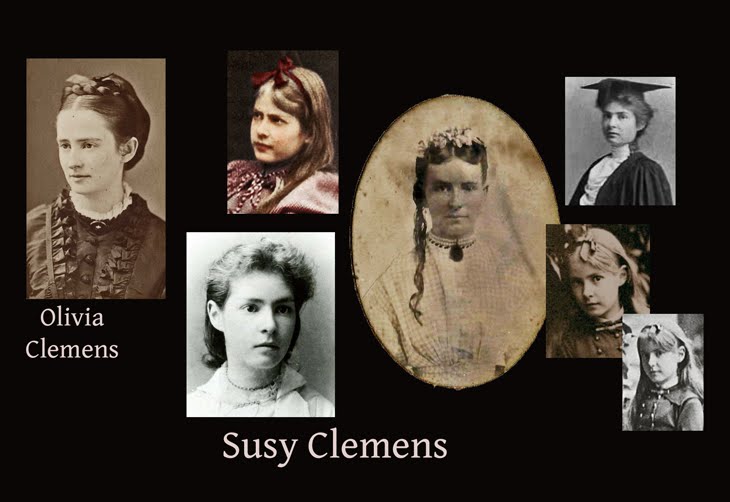
 

This was a tough one... (the oval in the middle) I thought this 
was Olivia for along time. The similarity between Olivia and
 her daughters was truly vexing. But the dress is more turn 
of the Century...

Susy was a young adult on her own for the last chapter in her life, attending school while the Clemenses toured Europe. She became sick and died while they were away. Perhaps there was more to it, but the Clemens were very private and protective of the Twain image. Hers was the first death in a string of losses which left Mark Twain devastated.

Not long after,  Olivia passed away from heart disease, and then just as Jean took the reins as woman of the house, she drowned in the bath tub one Christmas Eve, supposedly from an untimely epileptic seizure.

Clara was happily married to Ossip, and they spent a lot of time in Russia. They had one daughter, whose life would be more tragic than any of them. I have often wondered how these precious images got away, and were lost to history, and fear they were in her possession when she died of a drug overdose in California. There is a very strong presence of Clara, her mother, in the tintypes... But then she lived the longest, so that would make since. And this collection includes a great deal that would have been in the care of A.B. Paine... until his death.... and then... who knows

We will probably never know. 


Wednesday, October 31, 2018

The OTHER Women- in the Twain Legend

Mark Twain (Samuel Clemens) LOVED  women. Old ones, young ones... When his daughters were gone he informally adopted many young girls to run around with him. He called them his "angelfish." Perhaps the most famous of these was a child actress named Elsie Leslie. 


 This collection has numerous tintypes featuring the wonderful women in Mark Twain's life, and especially the other women... his childhood girl friend, cousins, female consorts while gallivanting out in California. It is an amazing selection of Victorian women, and leaves no doubt that Sam Clemens was a connoisseur of beauty.

 Mark Twain's first crush, and inspiration for the 
legendary Becky Thatcher of Tom Sawyer's neighborhood.
 This is a rare image of her when she was near the
 age described in Twain's iconic tale.


 Ella Creel was Sam Clemens's cousin, and no 
doubt his first experience of shock and awe 
and infatuation with the opposite sex. 


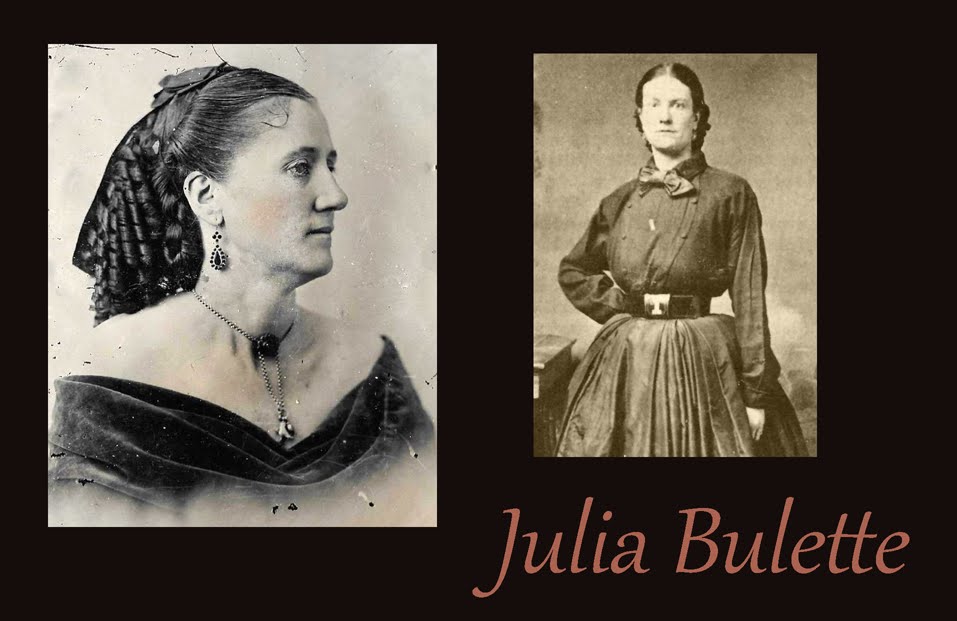
Perhaps the most famous madam in the west, Mark Twain
 no doubt knew Julia very early in his career when they
 both were operating their trades in Virginia City, Nevada.
Mine is the portrait on the left.


 The tintype in the middle started this whole avalanche
 of Twain's world. Mark Twain's most scandalous female 
associate was Adah Menken of New Orleans; actress,
 singer,equestrian performer and writer, and probably 
Confederate spy who befriended him while he
 covered her sensational shows in California... 
She wanted him to write her biography.


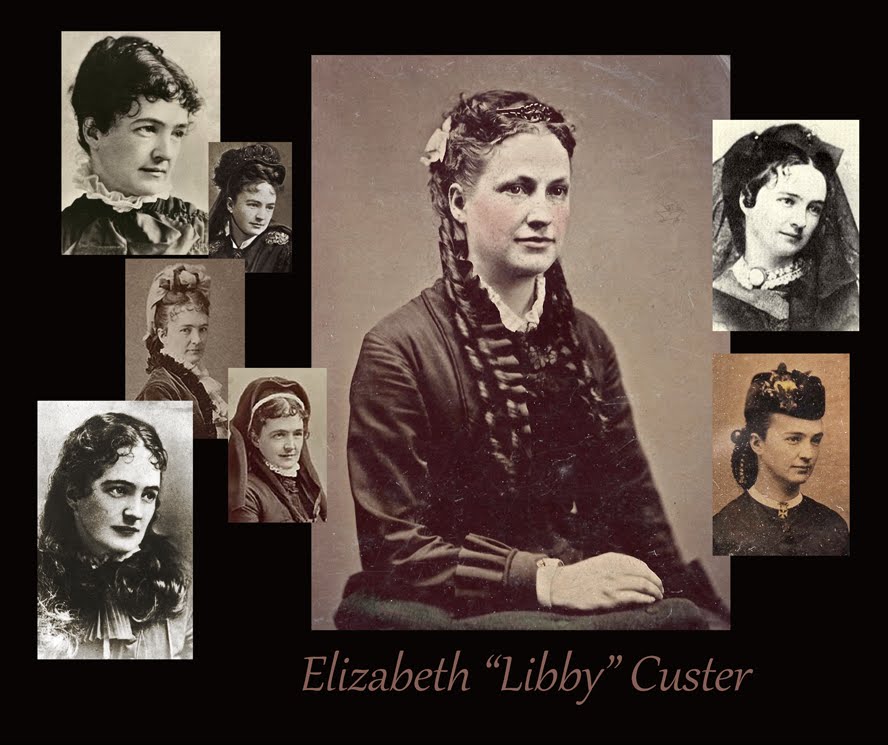
 One of the most beautiful women in Twain's social 
circle was Libby Custer, widow of famed Indian fighter
 General George Armstrong Custer. After his untimely
 death at the Battle of the Little Bighorn, Twain encouraged
her to write her memoirs, which she did. She named it 
Tenting on the Plains, and Twain's publishing 
company published it.

THE ART CONNECTION

As an artist, the collecting of these wonderful,  historic tintypes was made doubly satisfying by the emergence of scores of images to do with artists... and especially American artists who I had personally admired. But even more exciting was, as big a cynic as Mark Twain was, he knew and loved some of my personal favorites. I cannot rule out that the artists in the "Twain collection" may have been assembled by his wife Olivia, as she was an art enthusiast, and in fact helped to found an art school in Hartford Connecticut.

Some has been written already as to the cultural affinity between the writings of Mark Twain and the canvases of Winslow Homer. I cannot find where he ever owned a single work by Homer, but publishers have married the two by using Homer's Americana on the covers of many of Twain's books.

 A strange, "up the nostril" shaved head view of 
Winslow Homer (center), perhaps a tintype"selfie"!

Several tintypes in this collection surfaced that appeared to be Winslow Homer, which I initially had struggled to identify as Wyatt Earp instead. There were a few large, half-plate tintypes in the collection... more expensive, requiring some kind of frame, half-plate tintypes which suggest a greater status or personal  importance to the owner... and this unusually large tintype of Homer may be an American treasure as well...

One can never know, given Twain's satirical mind, just what he loved and what he despised, as he loved most that which he could lampoon and get the most laughs. In spite of his inborn skepticism and incessant sarcasm, he loved, and even wrote his adoration for the work of Frederic Church.

One of the premier American landscapists, Twain actually 
visited his studio and corresponded with him. Twain's taste  
 in art was right in sinc with his readership. Mine is the
 larger one in the middle.

The Twain archives also reveal at least correspondence with one of my personal idols, western artist Frederic Remington. Remington was an avid outdoorsman and sportsman, and is caught here wearing a baseball uniform.


Remington (mine enlarged in the center, and far right)
 when still nimble enough to play. He was the father
 of the Western or "cowboy" artists.

Remington and Twain were peers. Both wrote for the leading publication in the country, Harper's Monthly. I have not found an instance where Remington might have illustrated one of Twain's articles, but it surely came up. What little I know about each man, each was too egotistical to reach out to the other. But the mere presence of this photo suggests a quiet if not friendly competition between these two giants in American culture.